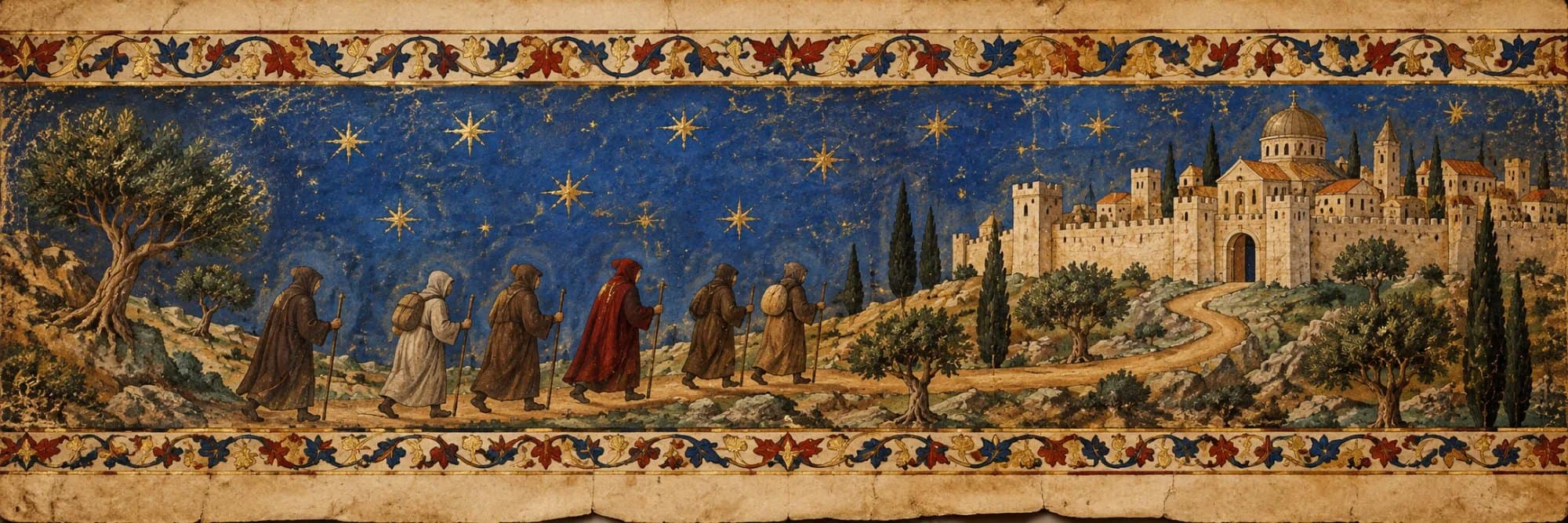
History of the Order
From the medieval Knights of the Temple to a modern international Christian chivalric community.
We present this history with respect for tradition, but also with a clear distinction between the medieval Order and its modern organizational forms.
Timeline
Eight centuries in eleven points
Early 12th c.
The historical Order arises in Jerusalem
1307
Arrest of the Templars in France
1312
Suppression of the historical Order
1314
Execution of Jacques de Molay
1705
Beginning of the modern organizational development
1804
Revival of activity in France
1894
Establishment of the Templar Secretariat in Belgium
1935
Emile Vandenberg becomes regent
WWII
Archives moved to Portugal for safekeeping
2012
Founding of the Grand Magistral Priorate of Serbia
2012–2026
Community development and building of its own Temple
Knights of the Temple in the Holy Land
The Order of the Poor Knights of Christ and of the Temple of Solomon arose in Jerusalem in the early 12th century. Its original mission was to protect Christian pilgrims and the routes to the holy sites.
Over the following two centuries the Order developed a strong religious, military, and administrative organization. Its members took vows and lived by rules that combined monastic discipline with chivalric service.
After the mass arrest of Templars in France in 1307, lengthy trials and pressure followed. Pope Clement V suppressed the historical Order in 1312. The last Grand Master, Jacques de Molay, was executed in 1314.
From legacy to the modern Order
The suppression of the historical Order ended its institutional life at that time. Yet the memory of the Templars — their faith, discipline, brotherhood, and tragic fate — lived on in European history and culture.
Modern Templar organizations should not be presented as an unbroken legal continuation of the medieval Order. They carry its spiritual and historical inspiration forward, seeking to apply chivalric ideals to peacetime, humanitarian, and socially responsible action.
The modern history of the Order
The Order's modern organizational development dates to the early 18th century.
According to the published history of the international Order, its modern form was established in 1705 under the patronage of the Duke of Orléans. After a period of decline, activity was revived in France in 1804, during the time of Napoleon Bonaparte.
A significant role in that period was played by Bernard-Raymond Fabré-Palaprat. After his death in 1838, leadership passed to Sir William Sidney Smith, who remained at the head of the Order until his death in 1858.
By the end of the 19th century the center of activity gradually shifted from France to Belgium, where the Templar Secretariat was established in 1894. In 1935, Emile Clement Joseph Isaac Vandenberg was elected regent.
During the Second World War the Order's archives were moved to Portugal for protection from the dangers of war. Further organizational development continued in Portugal, from which the broad international community of Grand Priories gradually emerged.
Grand Magistral Priorate of Serbia
The Grand Magistral Priorate of Serbia was founded in 2012 as part of the international Templar community.
From its founding to today it has developed its own organization, brought together members of different professions and life experience, and built its own Temple. In fourteen years a community has been created, founded on trust, responsibility, shared work, and fraternal support.
Our ongoing task is not to preserve the legacy we received as a museum piece, but to confirm it through life and deeds.
“Our ongoing task is not to preserve the legacy we received as a museum piece, but to confirm it through life and deeds.”
This account of the modern Order's history is based on the published history of the Great Priory of England. osmth-england.org